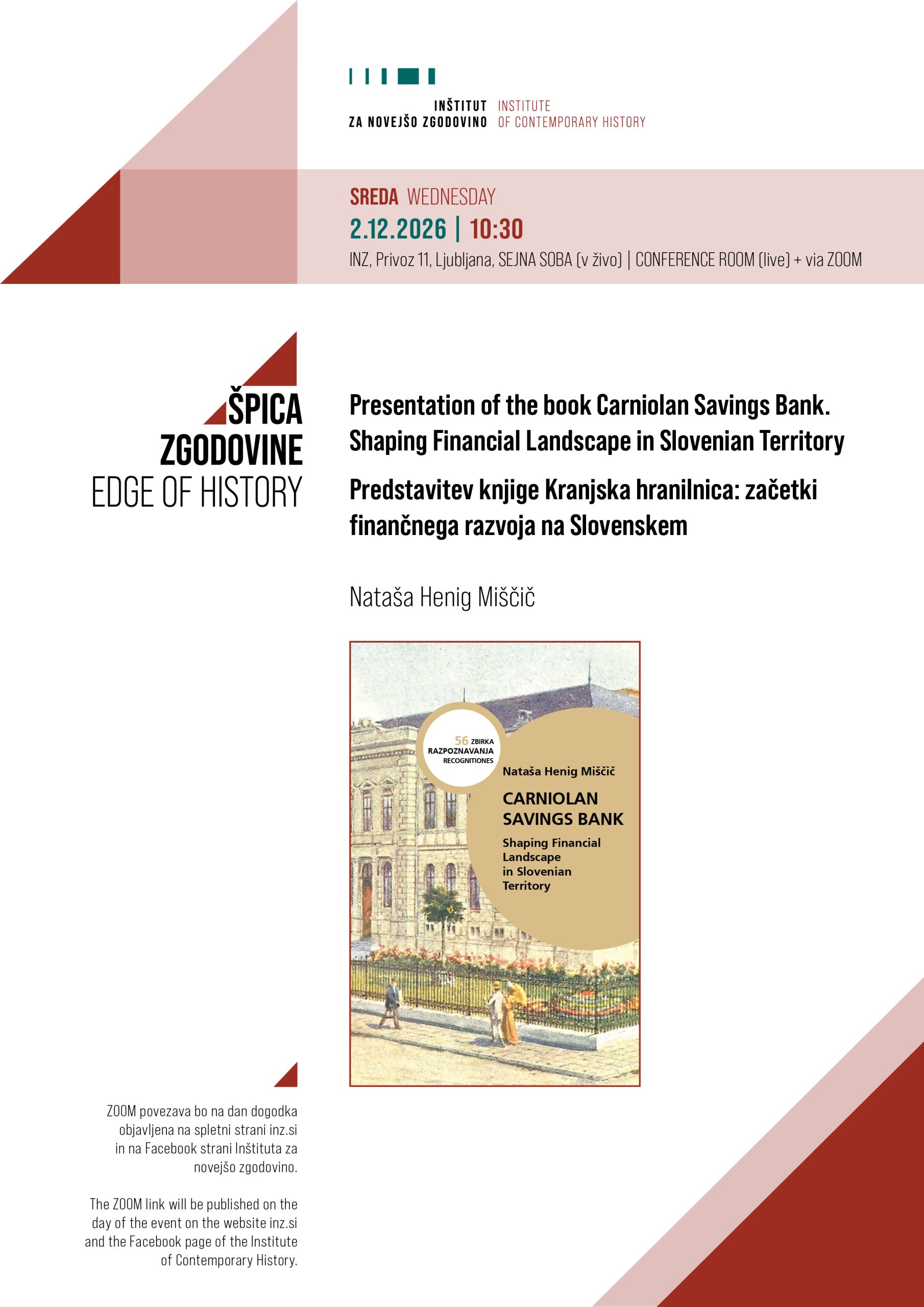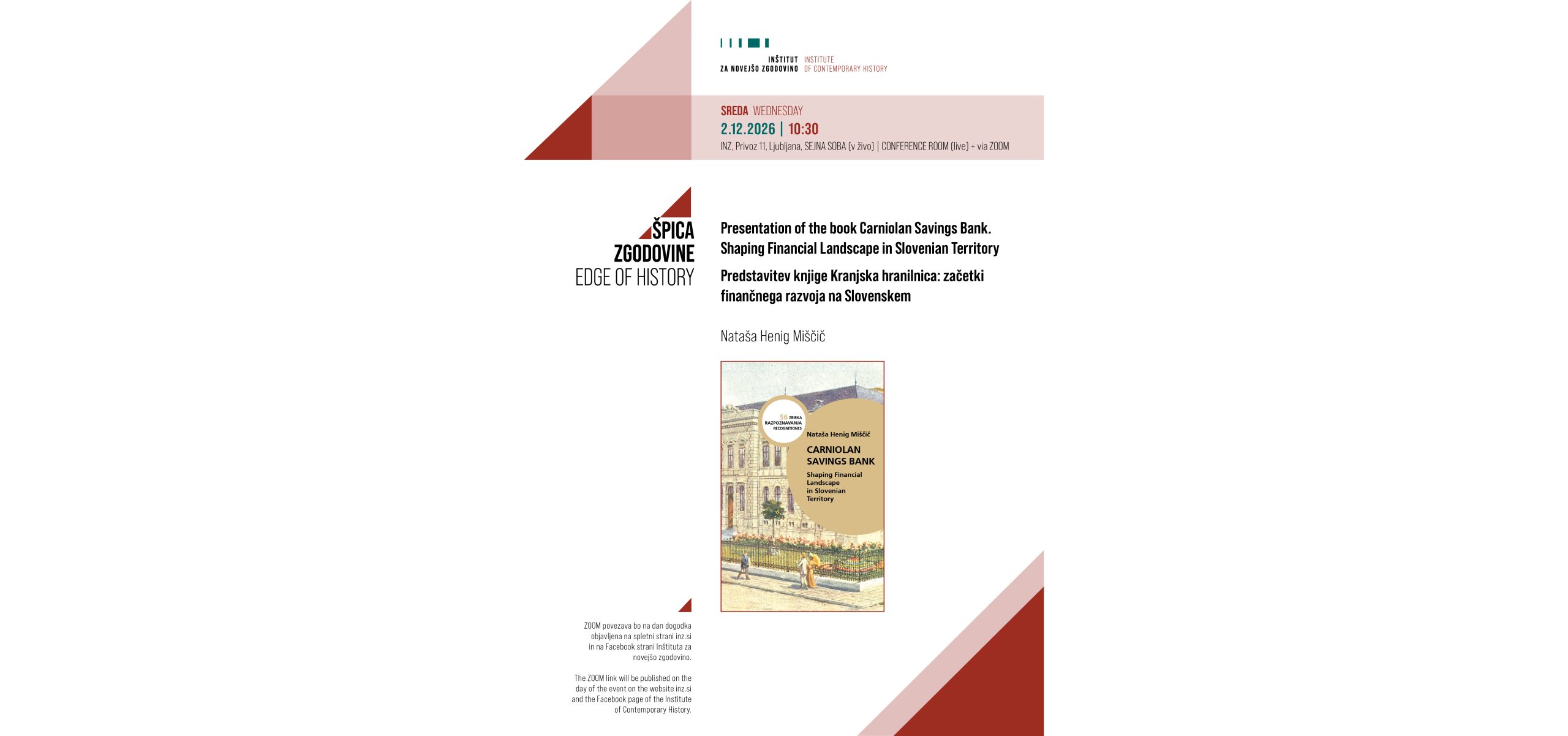
Edge of History: Carniolan Savings Bank: Shaping Financial Landscape in Slovenian Territory
You are kindly invited to an event in the new spinoff lecture series, the Edge of History. The new series focuses on the work of researchers from the Institute of Contemporary History, on their projects and new publications. The lecture will take place on Wednesday, December 2nd, 2026, at the INZ premises or via the ZOOM link: https://us06web.zoom.us/j/84664422400?pwd=b61EIvRBkMcapTCUwbscnA3NtuNS6K.1. In the new series, lectures will take place at 10.30 and if you will be joining us in person, you are welcome to a coffee 20 minutes before the lecture begins.
This time the presentation will be given by Nataša Henig Miščič, who will present her monograph titled Carniolan Savings Bank: Shaping Financial Landscape in Slovenian Territory. The lecture will be held in English.
The book traces the history of the Carniolan Savings Bank, founded in Ljubljana in the early nineteenth century to encourage saving and expand access to financial services. The savings bank became a key institution in the province’s economic development and social welfare, and from the outset it was more than a financial institution: its establishment and activities were closely tied to the economic conditions and community life of the region. The book also examines the later period of growing national tensions and the interwar years, showing how the savings bank’s story reflects the wider changes in the region.
This presentation concentrates on the earlier period of the savings bank’s activity, before national differentiation and before it came to be labelled a German financial pillar. It focuses on the founding of the savings bank and its early development within the broader context of the Habsburg Monarchy. It asks how an institution created to promote thrift and improve access to financial services came to play a role that reached well beyond finance. Through its cultural and philanthropic activities, the savings bank became an important part of the wider community, helping to shape the financial landscape of Slovenian territory and showing how financial institutions can influence both community life and broader societal development.