
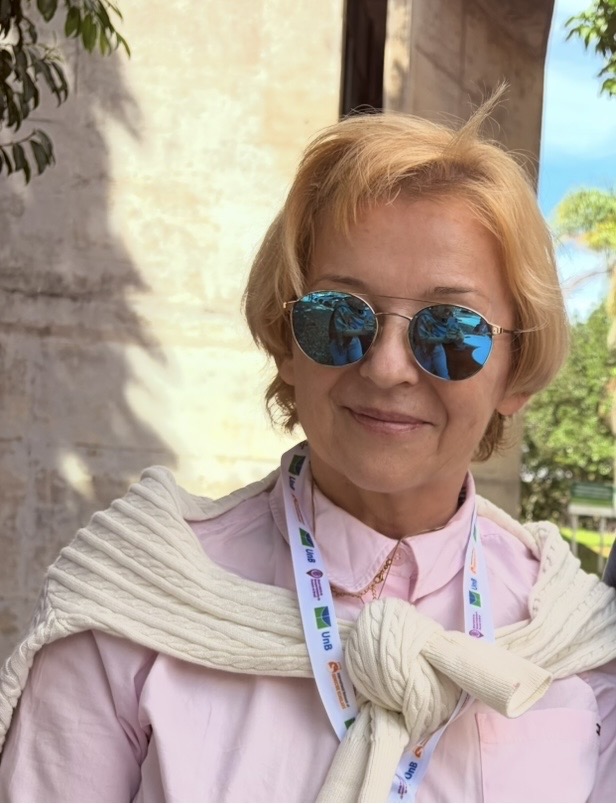
Wioletta Rebecka, PhD
Researcher, Rape: A history of shame Project, NYC, USA
Dr Wioletta B. Rebecka is a psychologist and researcher whose work examines the psychological, social, and political consequences of war, genocide, conflict-related sexual violence, torture, displacement, and collective trauma. Her research is grounded in long-term engagement with survivors and communities affected by political violence across different cultural and historical contexts. Since 2018, she has collected more than 400 testimonies related to conflict-related sexual violence, torture, war, and their intergenerational consequences. Her research and academic collaborations have included work in Rwanda, the Democratic Republic of the Congo, Kosovo, Bosnia and Herzegovina, Ukraine, Kenya, Tanzania, South Africa, Poland, and the United States. Rebecka developed War Rape Survivors Syndrome (WRSS) and the Social and Political Nervous System (SPNS), a theoretical framework examining the dynamic relationship between individual psychological regulation and the social and political environments in which people live. Her current research extends this work to silence, food practices, cultural memory, suicide, collective regulation, and the intergenerational transmission of survival following war and political violence.
Her recent peer-reviewed publications address WRSS and Dislocation of Meaning, transgenerational trauma, the Social and Political Nervous System, and methodological questions concerning knowledge production from survivor testimony. She is the author of Rape: A History of Shame—Diary of the Survivors and serves as a Board Director of the Institute for Humanitarian Conflict Resolution in New York. During her 2027 fellowship at the Institute of Contemporary History in Ljubljana, Rebecka is particularly interested in developing interdisciplinary cooperation around suicide, food, silence, and other psychological and social expressions that may carry histories of collective violence across generations. She is especially eager to explore suicide in relation to war, historical trauma, social regulation, and intergenerational transmission, including the legacies of the Holocaust and the wars in the former Yugoslavia. Through collaboration with Slovenian scholars, she hopes to examine how experiences that are difficult to articulate directly may remain socially and psychologically present through silence, bodily regulation, family practices, everyday behavior, and relationships to survival.
Statement of interest:
My interest in the fellowship at the Institute of Contemporary History in Ljubljana is closely connected to my previous work in Kosovo and Bosnia and Herzegovina and to the development of the Social and Political Nervous System (SPNS). In Kosovo, I worked with survivors of conflict-related sexual violence, collected testimonies, participated in conferences, and cooperated with the Kosova Rehabilitation Centre for Torture Victims (KRCT). In 2021, this cooperation included training related to the Government Commission responsible for the recognition and verification of the status of survivors of sexual violence during the Kosovo war. In Bosnia and Herzegovina, I continued collecting testimonies of survivors of wartime sexual violence and worked with Medica Zenica, where I also presented my book Rape: A History of Shame—Diary of the Survivors. This work was also discussed in an interview with Al Jazeera. My work in both countries brought me repeatedly to the same problem: the relationship between people who survived atrocities and the societies in which they continue to live after the violence has formally ended. Survivors remain part of social environments that may recognize some experiences while avoiding, silence, or selectively remembering others. This interaction between the individual and the surrounding social system has become central to my development of SPNS. I am interested in what happens when survivors carry out experiences that the larger society does not openly discuss, and how this relationship affects both individual and collective regulation across generations.
The fellowship in Slovenia offers an important opportunity to develop this work within a society shaped by several intersecting histories, including the Holocaust, the Second World War, socialist Yugoslavia, and the wars associated with the dissolution of Yugoslavia. I am interested not only in what is historically remembered, but also in what remains difficult to articulate and how these silences function within contemporary society. Within this broader SPNS research, I am particularly eager to develop cooperation with Slovenian scholars around suicide. I would like to investigate possible relationships between suicide, historical experiences of war and atrocity, social silence, and intergenerational processes, while avoiding explanations that isolate suicide from its historical and social environment. I am also interested in food and other everyday practices as possible sites through which experiences of survival, deprivation, memory, and silence continue to interact with contemporary life. My goal during the fellowship is therefore to further develop SPNS through sustained interdisciplinary dialogue between psychology and contemporary history. Slovenia provides an important context for examining the continuing relationship between people carrying direct or inherited experiences of political violence and the social environment that remembers, reorganizes, or remains silent about that past.
Selected Publications:
- Rebecka, W. B. (2026). Rethinking Grief in the Context of Ongoing War in Ukraine. Brill. https://doi.org/10.1163/29502683-bja00033
- Rebecka, W. (2026). The Social and Political Nervous System Framework for Understanding Collective Recovery After War or Genocide. Discover Psychology, Springer Nature. https://doi.org/10.1007/s44202-026-00809-1
- Rebecka, W. (2026). Dislocation of Meaning: When Psychology Becomes an Oppression—War Rape Survivors Syndrome (WRSS). Psychology, 17(1), 17–54. https://doi.org/10.4236/psych.2026.171002
- Rebecka, W. (2025). Africa as a Healer: Reclaiming Indigenous African Systems of Justice and Restoration. African Journal of Economics, Politics and Social Studies, 4(2). https://doi.org/10.15804/ajepss.2025.2.06
- Rebecka, W. (2025). The Transgenerational Cycle: From Memory to Molecule and from Molecule to Memory—The Multilayered Transmission of Trauma. Psychology, 16(12), 1475–1499. https://doi.org/10.4236/psych.2025.1612085
- E-naslov:
- wiolar809@gmail.com