
Dr. Ivan Sablin: »The USSR Supreme Soviet in 1955–1991: Functions of a State Socialist Parliament«
Zgodovina na Špici / History on the Edge
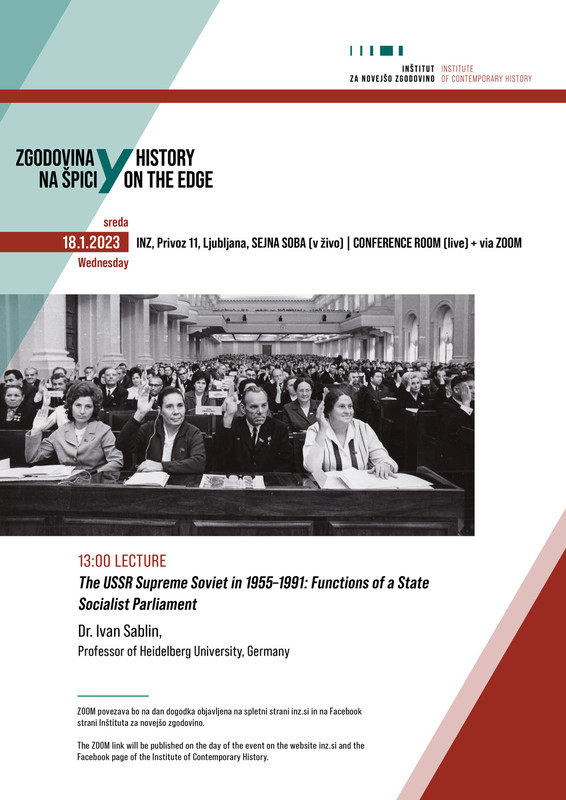
V sredo, 18. 1. 2023 ob 13. uri, bo v sejni sobi Inštituta za novejšo zgodovino potekalo predavanje Dr. Ivana Sablina (Univerza v Heidelbergu, Nemčija), z naslovom »The USSR Supreme Soviet in 1955–1991: Functions of a State Socialist Parliament«
Predavanje bo v angleškem jeziku, in bo na voljo tudi preko ZOOM-a.
Lepo vabljeni!
Zoom Meeting: ZOOM
Meeting ID: 878 3613 3014
Abstract:
From a normative liberal standpoint, the USSR Supreme Soviet was not a parliament. It consisted of deputies, chosen by the Central Committee of the Communist Party and approved in uncontested elections, did not have any agency in legislation, apart from sanctioning pre-made laws, and had no control over the Council of Ministers. Short and rare sessions did not allow it to have any substantial discussions and even to pass the pre-made laws, with most legislation being approved by the standing Presidium of the Supreme Soviet. At the same time, the Supreme Soviet had a number of extraconstitutional functions within the Soviet system. Its most important function was that of a feedback mechanism through which Soviet citizens could inform the government of their grievances and which contributed to fine-tuning of the official policies. This function was performed through communication with individual deputies and with the Presidium. The Supreme Soviet also played an important part in Soviet diplomacy and foreign propaganda, sending out and receiving dozens of parliamentary delegations and participating in the Inter-Parliamentary Union. The attempts to turn the Supreme Soviet into a working legislature, undertaken in 1988–1991, demonstrated that the performance of constitutional functions was incompatible with that of the existing extraconstitutional ones and with the very design of the Supreme Soviet, which contributed to the failure of perestroika’s political reform. This lecture reconstructs the extraconstitutional functions of the Supreme Soviet and traces the transformation of the institution during perestroika through archival materials, ego documents of deputies, and verbatim reports.
About the author:
Dr Ivan Sablin is a leader of the Research Group “Entangled Parliamentarisms: Constitutional Practices in Russia, Ukraine, China and Mongolia, 1905–2005” at Heidelberg University in Germany. His research interests include history of the Russian Empire and the Soviet Union, with special attention to Siberia and the Russian Far East, histories of parliaments, empires, and diversity, and global intellectual history. He is an author of two monographs – Governing Post-Imperial Siberia and Mongolia, 1911–1924 (London: Routledge, 2016) and The Rise and Fall of Russia’s Far Eastern Republic, 1905–1922 (London: Routledge, 2018). Currently, I work on a monograph devoted to the conceptual and institutional history of parliaments in Russia and the Soviet Union between 1905 and 1955. Within his time as a Visiting Fellow at the Institute of Contemporary History in Ljubljana, Dr. Sablin engages in comparative studies of parliamentarism, federalism, and other concepts under state socialism in a global context, comparing concepts pertaining to parliaments and parliamentary institutions in Yugoslavia, Czechoslovakia, and the USSR between the 1960s and 1991.