
Juhan Saharov: »From Economic to Political Sovereignty: Inventing “Self-Management” in Late Soviet Estonia (1987—89)«
Zgodovina na Špici / History on the Edge
You are kindly invited to the new event of the History on the Edge series, which will take place on Wednesday, February 19 2025 at 13:00, at the INZ premises or at the ZOOM link: https://us06web.zoom.us/j/86949706378
The lecture will be given by Juhan Saharov, and the title of the lecture is “From Economic to Political Sovereignty: Inventing “Self-Management” in Late Soviet Estonia (1987—89)”. The lecture will be held in English.
From Economic to Political Sovereignty: Inventing “Self-Management” in Late Soviet Estonia (1987—89)
In the autumn of 1988, Estonian economist Erik Terk arrived in Sofia to present new economic ideas to his perestroika-friendly Bulgarian colleagues. His presentation on the Estonian self-management project—which proposed transferring control of enterprises, taxation, and financial matters from Moscow to the republic level—was met with unexpected scepticism. Bulgarian colleagues refused to engage with the project`s title, immediately associating it with Yugoslavia’s model of workers’ self-management, which was considered taboo in Bulgaria. However, both sides drew on different intellectual traditions while using the same term. The Estonian model represented a conceptual innovation of the old Soviet concept of khozraschet (enterprise self-sufficiency), while Bulgarian economists interpreted the terminology exclusively through the Yugoslav model. This illuminates how identical terms carried different meanings across the socialist world, shaped by local contexts and languages.
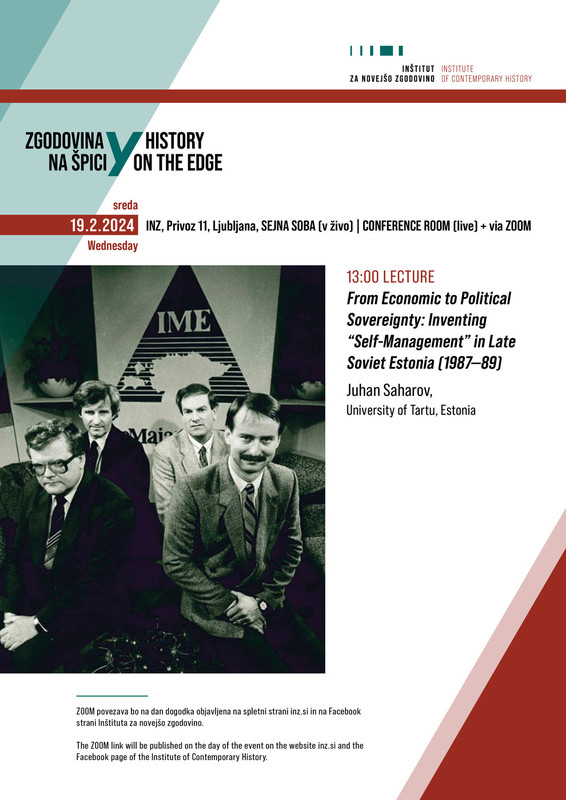
This lecture examines the possibility of conceptual innovations in authoritarian one-party regimes. In moments when the regime’s pressure has eased but only a limited number of ideological languages are available, what kind of terms and concepts can be used to effect political change? The project of territorial self-management (IME program), proposed by four Estonian scholars in September 1987 (in the photo), was based on the idea that a Soviet republic—as a territorial unit—should operate as an independent enterprise. Within a year, this idea mobilized the nation, eventually shifting the focus from economic to political sovereignty, activating the parade of sovereignty declarations across the Soviet Union. Finally, the lecture describes how the IME leaders sought to learn from the experience in East Central Europe, including Slovenia. Their first visit to Ljubljana (1989) aimed to learn from the Yugoslav federalist model, and the second (1990) was to build cooperation between the political forces striving for independence.