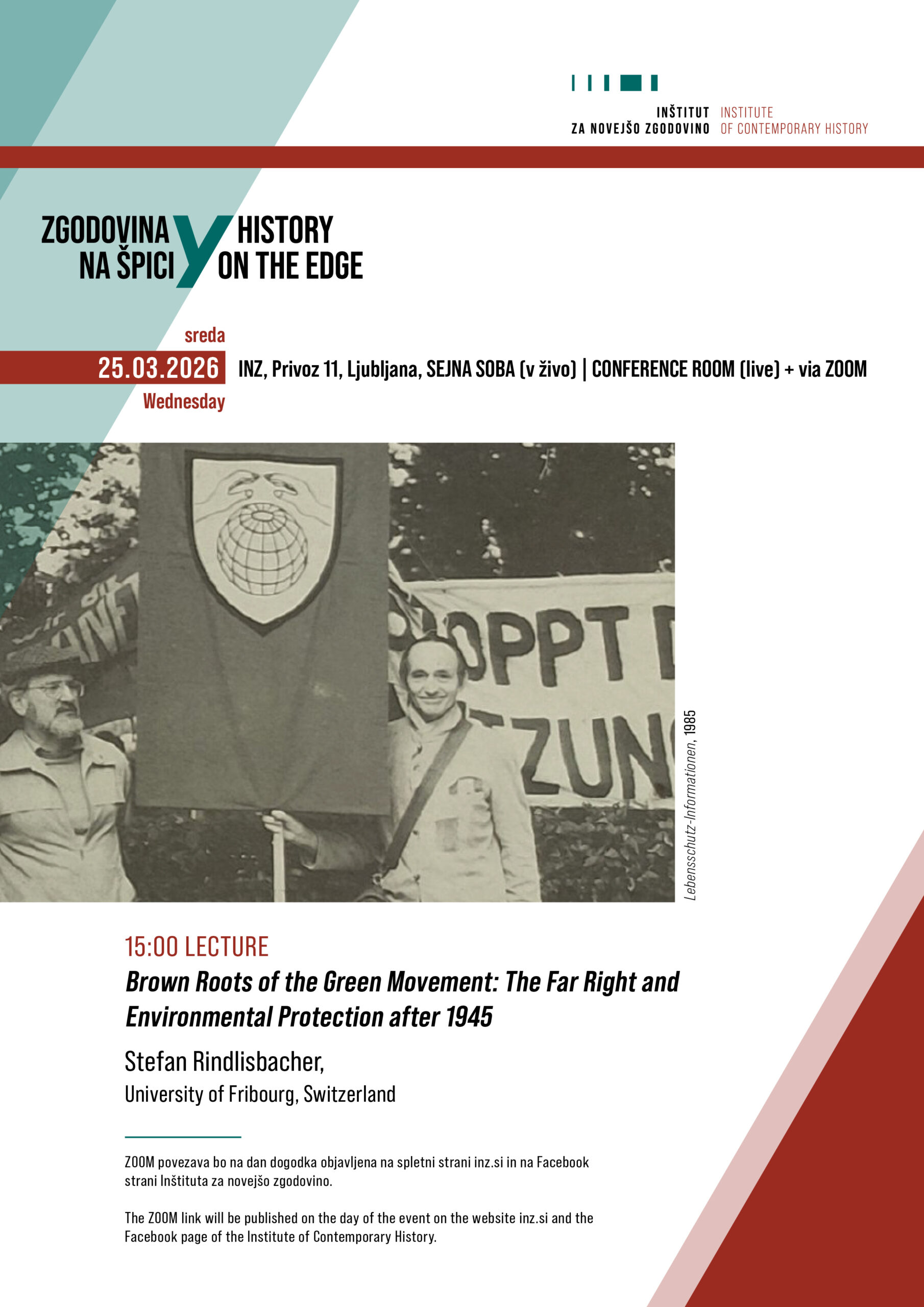
HISTORY ON THE EDGE: BROWN ROOTS OF THE GREEN MOVEMENT: THE FAR RIGHT AND ENVIRONMENTAL PROTECTION AFTER 1945
You are kindly invited to a new lecture in the History on the Edge series, which will take place on Wednesday, March 25, 2026, at the INZ premises or via the ZOOM link: https://us06web.zoom.us/j/85093074535?pwd=chFdSCgScVg8fw1djh3bVz8h9gqWtm.1 . In the new season, lectures will take place at 3 p.m. and if you will be joining us in person, you are welcome to a coffee 20 minutes before the lecture begins.
The lecture will be given by Stefan Rindlisbacher, and the title of the lecture is “Brown Roots of the Green Movement: The Far Right and Environmental Protection after 1945”. The lecture will be held in English.
Brown Roots of the Green Movement: The Far Right and Environmental Protection after 1945
The environmental movements of the 1960s and 1970s and the green parties formed in the 1980s are widely regarded as key drivers of democratic innovation. Their calls for ecological justice, sustainability and political responsibility are often closely associated – especially in German-speaking countries – with the New Left and its experiments with new forms of democracy following the 1968 protests.
What is far less known, however, is the significant role that far-right actors played in shaping environmental activism, including the anti-nuclear movement. A prominent example is the Austrian writer and former Nazi Günther Schwab, whose 1958 book Dance with the Devil warned of environmental dangers such as pesticides, air pollution, radioactivity and deforestation several years before Rachel Carson’s Silent Spring. Yet Schwab embedded all these concerns in a worldview marked by racism and eugenics, insisting that ecological protection served above all to defend the so-called “white race.” Moreover, the emergence of green parties, particularly in Germany and Austria, was influenced by former Nazis and far-right activists such as Werner Haverbeck, August Haußleiter and Baldur Springmann. Their involvement reveals that the early environmental field was far more ideologically heterogeneous than later narratives suggest.
This presentation examines these “brown roots” of environmental activism and green party formation, with a particular focus on German-speaking countries. It also offers a first, exploratory look at cases such as Slovenia, where ecological parties developed under markedly different historical and political conditions.