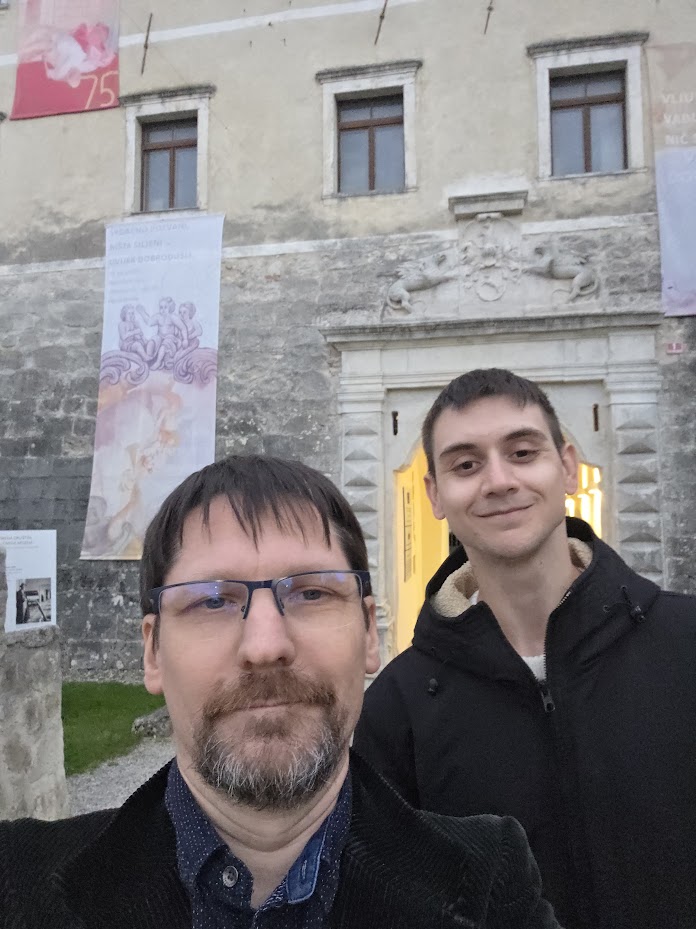
41st Annual Meeting of the Association of Historical Societies of Slovenia
Members of the research groups Economic, Social, and Environmental History of Slovenia and Digital Humanities participated in the 41st Annual Meeting of the Association of Historical Societies of Slovenia, held in Brežice on October 1 and 2, 2025.
The participants included:
-
- Filip Dobranić: Korpus sPeriodika
- Sara Šifrar Krajnik: The Alpine River Landscape and Hydroelectric Infrastructure: Power Plants in the Upper Sava Valley and the Radovljica Basin at the Beginning of the 20th Century
- Dr. Marta Rendla: presentation of the monograph Potenciali in upravljanje voda: med preteklostjo in sedanjostjo (Potentials and Water Management: Between the Past and the Present) and the paper The Centennial Floods in Slovenia in 1990
- Dr. Meta Remec (moderator of the panel History of Floods in Slovenia from the 19th Century to the Present), invited speaker with the papers Researching Environmental History: Local Approaches and Global Themes and Village Quarrels, Jealousy, and Family Tragedies: Suicide in a Microhistorical Perspective
- Dr. Nataša Henig Miščič: Floods in the Ljubljana Marsh during the Second Half of the 19th and the First Half of the 20th Century
- Dr. Ivan Smiljanić (moderator of the panel Digital Historiography: Databases–Viewers–Analyses): Floods in Slovenia during the First Yugoslavia and Views on Partisan Suicides in Socialist Yugoslavia
- Dr. Lev Centrih (moderator of the panel Observation, Recording, and Appropriation in the Socio-Historical Context: Between Discourse and Reality in Examples from the Economy and Cultural Heritage) and the paper Floods in Slovenia in 1948 and Their Consequences for Agricultural Enterprises and Economies in the Ljubljana Marsh
- Dr. Dunja Dobaja: Slovenia’s Response to Floods after 1991
- Dr. Janja Sedlaček: Perceptions of the Relationship Between Humans and Nature: The Case of the Trnovo Hydroelectric Power Plant
The event was richly documented and recorded by Robert Vurušič and students Žiga Volf Stepančič and Tonja Jerkič.
The post shares a few highlights from the meeting, which underscored the importance of interdisciplinary approaches in researching Slovenia’s past.