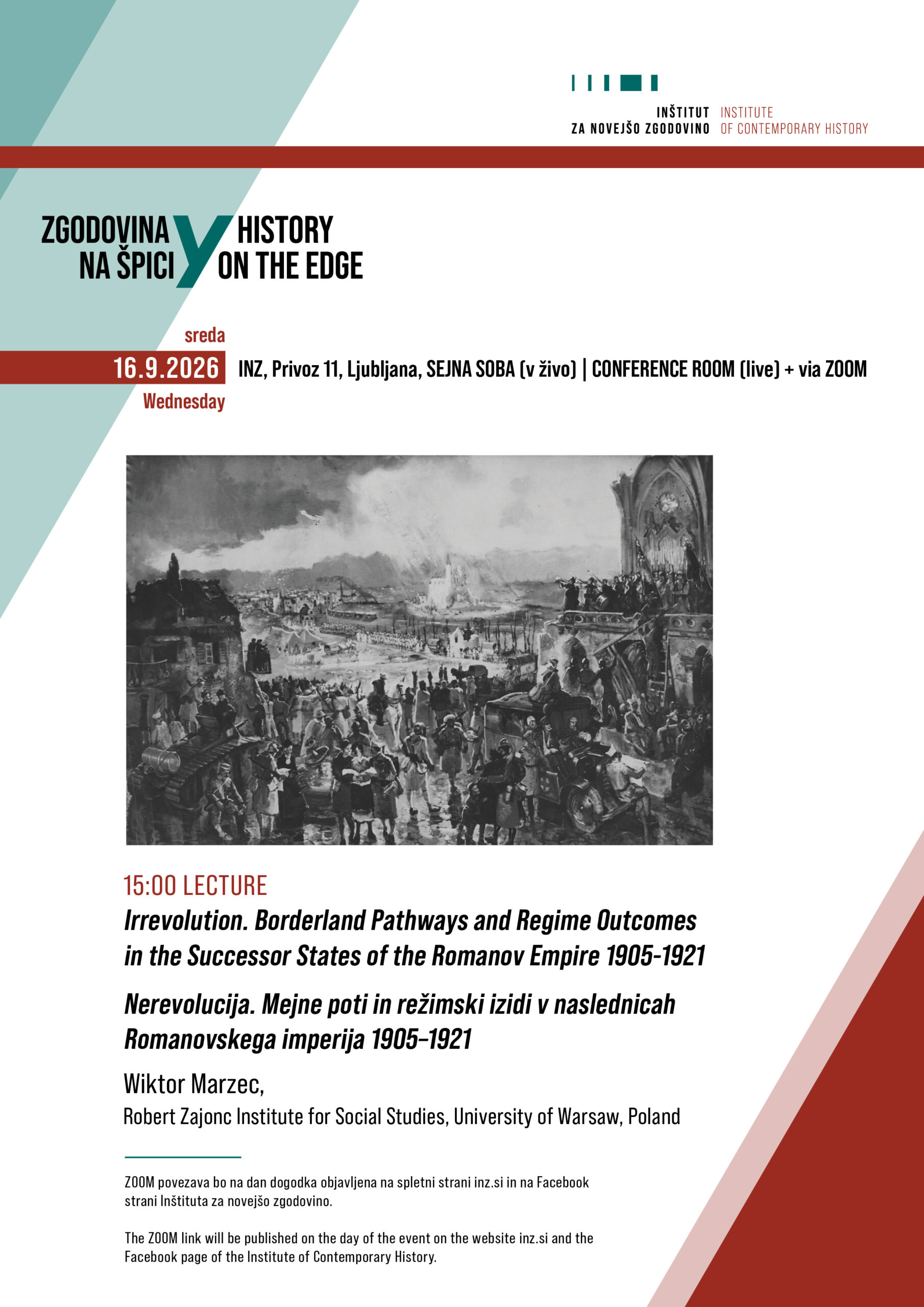
HISTORY ON THE EDGE: IRREVOLUTION. BORDERLAND PATHWAYS AND REGIME OUTCOMES IN THE SUCCESSOR STATES OF THE ROMANOV EMPIRE 1905-1921
You are kindly invited to a new lecture in the History on the Edge series, which will take place on Wednesday, September 16, 2026, at the INZ premises or via the ZOOM link: https://us06web.zoom.us/j/84664422400?pwd=b61EIvRBkMcapTCUwbscnA3NtuNS6K.1 . In the new season, lectures will take place at 3 p.m. and if you will be joining us in person, you are welcome to a coffee 20 minutes before the lecture begins.
The lecture will be given by Wiktor Marzec, and the title of the lecture is “Irrevolution. Borderland Pathways and Regime Outcomes in the Successor States of the Romanov Empire 1905-1921”. The lecture will be held in English.
Irrevolution. Borderland Pathways and Regime Outcomes in the Successor States of the Romanov Empire 1905-1921
This lecture investigates the divergent sociogenetic pathways and regime outcomes of four “overdeveloped” western peripheries of the Russian Empire—Poland, Finland, Georgia, and Latvia—as they transitioned from imperial rule to independent statehood. While these regions shared structural similarities, including high levels of urban industrialization and robust militancy during the 1905 Revolution, their trajectories toward sovereignty resulted in markedly different political makeups.
The comparative analysis reveals that in Finland, intense class conflict culminated in a civil war strictly divided along class lines; although the revolutionary “Reds” were defeated with German assistance, the resulting state remained a parliamentary democracy with a high level of social redistribution. In Latvia, where support for social revolution was widespread, the emerging national state achieved consolidation against the Bolshevik alternative through a radical “ethnic reversal”—a sweeping land reform that targeted the German landed elite to create a national Latvian peasantry. Georgia followed yet another path, where local Social Democrats (Mensheviks) successfully outmaneuvered opponents to establish an independent, stable socialist republic that balanced the claims of popular classes with the preservation of social order until its military reconquest by the Red Army in 1921. In contrast to these cases of internal revolutionary seizure or attempt, the Polish state consolidated through significant concessions made by a “popular government” to urban and rural non-elites, coupled with the repression of a relatively minor internal revolutionary contender. This “irrevolutionary” outcome was further secured by the defeat of an external Bolshevik threat.
The lecture aims to demonstrate how these divergent pathways were determined by a complex nexus of factors, including the 1905 experience, the unity of socialist politics, patterns of rural mobilization and their interactions with socialist politics, and the unintended consequences of inter-imperial competition. Ultimately, the talk aims at recalibrating the history of the national state, showing it to be an unlikely outcome of global imperial disintegration and a bitingly contested social order.
Zgodovina na Špici / History on the Edge