
HISTORY ON THE EDGE: Sporadic Trajectory of Eastern European Thought: Postwar Japanese Intellectuals and Their Source of Alternative Ideas
You are kindly invited to a new lecture in the History on the Edge series, which will take place on Wednesday, January 28, 2026, at the INZ premises or via the ZOOM link: https://us06web.zoom.us/j/85093074535?pwd=chFdSCgScVg8fw1djh3bVz8h9gqWtm.1 . In the new season, lectures will take place at 3 p.m. and if you will be joining us in person, you are welcome to a coffee 20 minutes before the lecture begins.
The lecture will be given by Anna Nakai, and the title of the lecture is “Sporadic Trajectory of Eastern European Thought: Postwar Japanese Intellectuals and Their Source of Alternative Ideas”. The lecture will be held in English.
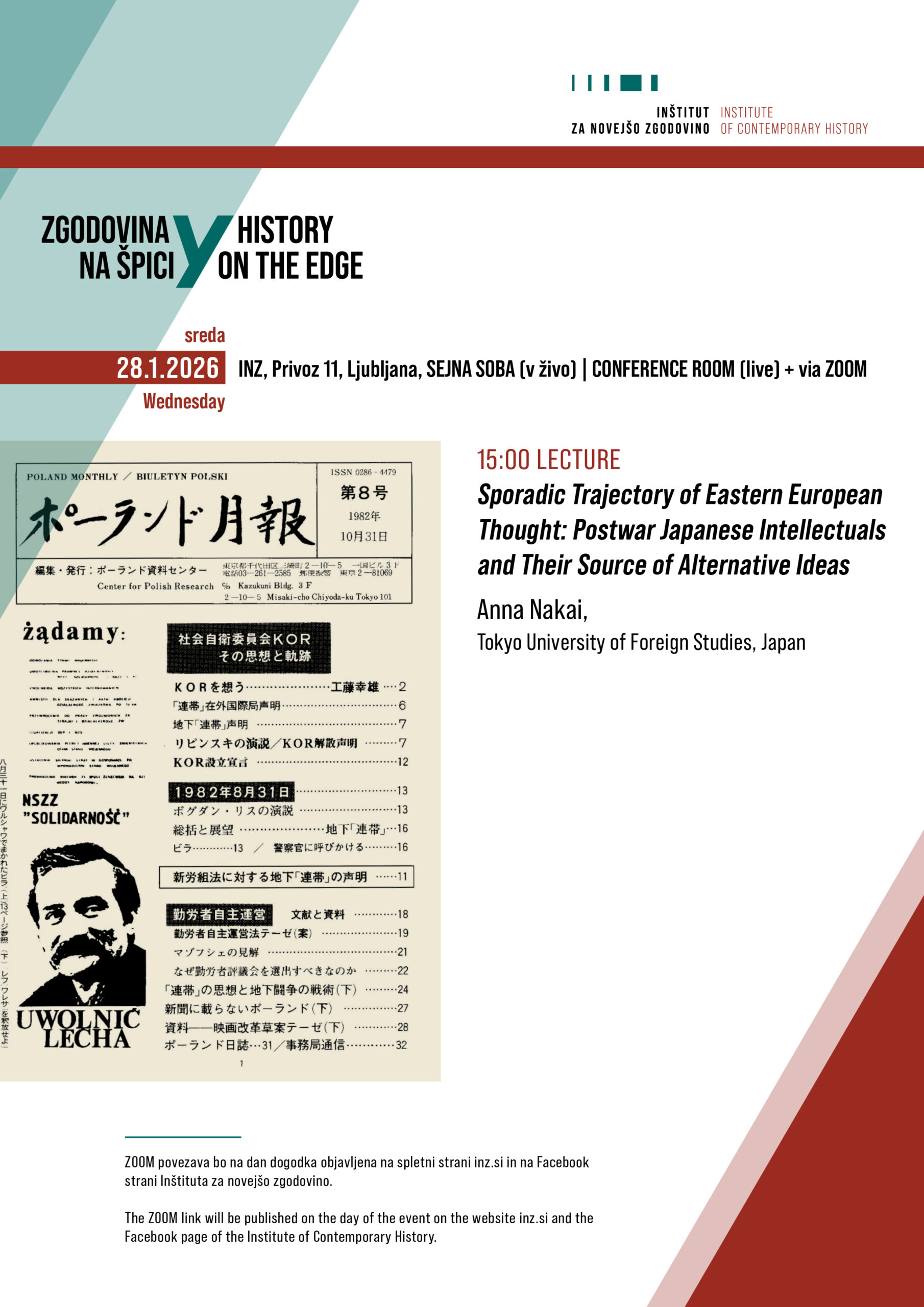
Sporadic Trajectory of Eastern European Thought: Postwar Japanese Intellectualsand Their Source of Alternative Ideas
This presentation aims to demonstrate how intellectual productions from Eastern Europe were received in post-war Japan, not as a coherent development but as a series of irregular and discontinuous encounters. From the 1950s to the early 1990s, Japanese critics and activists approached Eastern European thought in a selective and reactive manner at key events of global upheaval.
Rather than tracing linear and direct influences, it is important to understand how these fragmented contacts influenced Japanese debates on socialism, humanism, and nationalism. How did a Hungarian communist ignite the Japanese architectural discussion? In what way did Marxist humanism impact a Japanese peace activist? Why did the Polish labor union movement become so popular during the growth of Japanese capitalism? The ideas from Eastern Europe entered Japan irregularly, providing alternatives to both Soviet orthodoxy and Japan’s own political imagination throughout the Cold War era.
The symbolic power of Eastern Europe had faded within the country by the early 1990s. The collapse of state socialism brought not clear direction but a weakening of the concept of region as meaningful frameworks for understanding. Ultimately, by connecting some dots (people) with the lines (receptions), I can emphasize how these episodic moments shaped Japan’s unique path through the global history of socialism.