
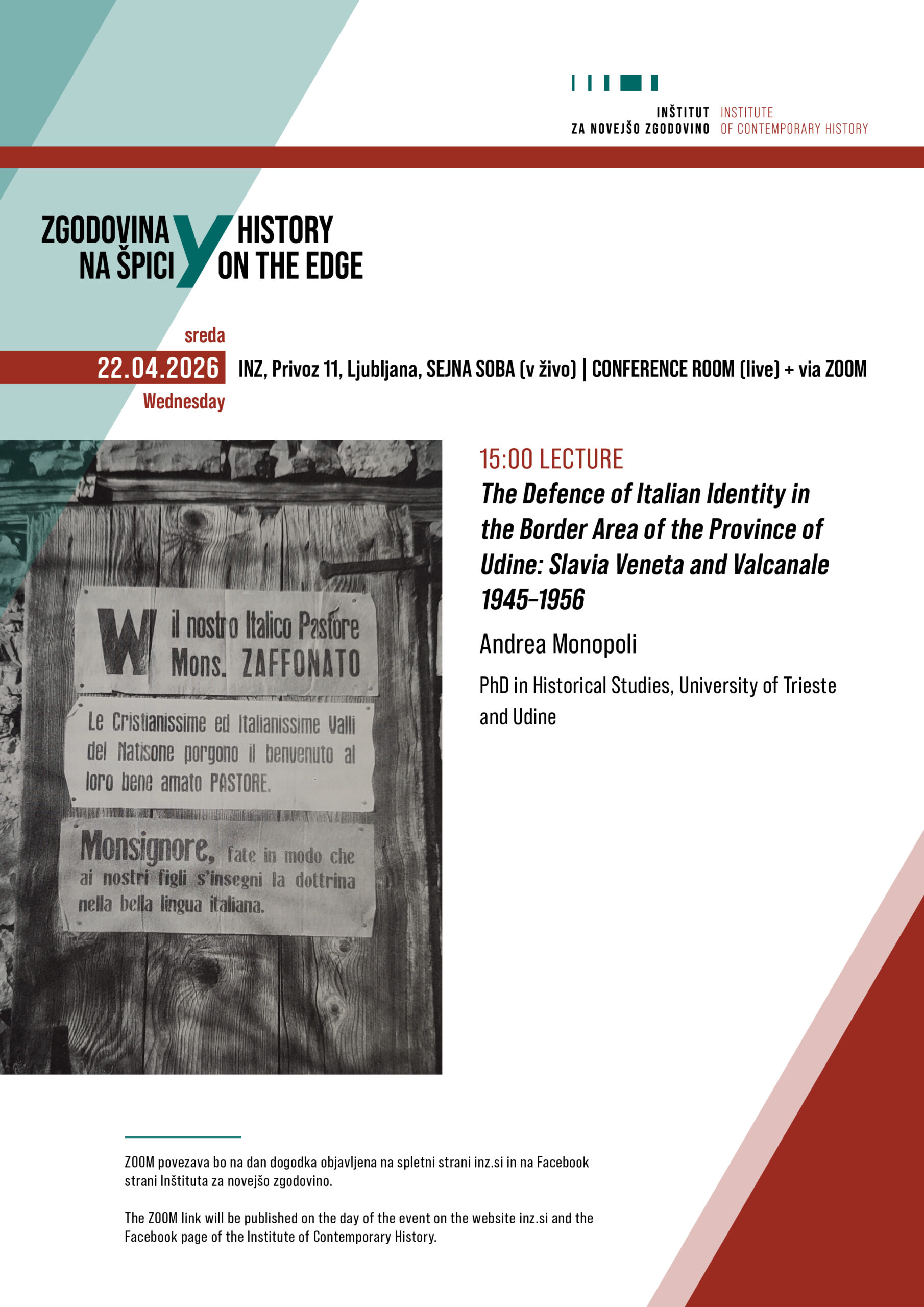
HISTORY ON THE EDGE: THE DEFENCE OF ITALIAN IDENTITY IN THE BORDER AREA OF THE PROVINCE OF UDINE: SLAVIA VENETA AND VALCANALE 1945–1956
You are kindly invited to a new lecture in the History on the Edge series, which will take place on Wednesday, April 22, 2026, at the INZ premises or via the ZOOM link: https://us06web.zoom.us/j/85093074535?pwd=chFdSCgScVg8fw1djh3bVz8h9gqWtm.1 . In the new season, lectures will take place at 3 p.m. and if you will be joining us in person, you are welcome to a coffee 20 minutes before the lecture begins.
The lecture will be given by Andrea Monopoli, and the title of the lecture is “The Defence of Italian Identity in the Border Area of the Province of Udine: Slavia Veneta and Valcanale 1945–1956”. The lecture will be held in English.
The Defence of Italian Identity in the Border Area of the Province of Udine: Slavia Veneta and Valcanale 1945–1956
The research examines the strategies through which the Italian state and local actors defended the Italian identity of the border territory in the province of Udine during the post-war period. The investigation focuses on the relationship between centre and periphery, viewed both top-down –namely, in the policies devised at the governmental level and enacted locally – and bottom-up, that is, in the ways in which demands and pressures from the territory helped shape Rome’s responses. Particular attention is paid to the social, political and cultural effects of the measures adopted, set within the broader context of the Cold War and relations between Italy and Yugoslavia. The research also considers forms of resistance to the process of Italianization, identifying its protagonists, motivations and instruments. The period under analysis (1945–1956) stretches from the end of the Second World War to the dissolution of the “O” Organization, an event that marked the end of the phase in which, in this territory, the defence of Italian identity and nationalist tensions reached their peak. This timespan also makes it possible to grasp the shift from the spontaneous, locally driven initiatives of the immediate post-war years to the direct involvement of the State in the management of border areas, in conjunction with the consolidation of the bipolar international system.