
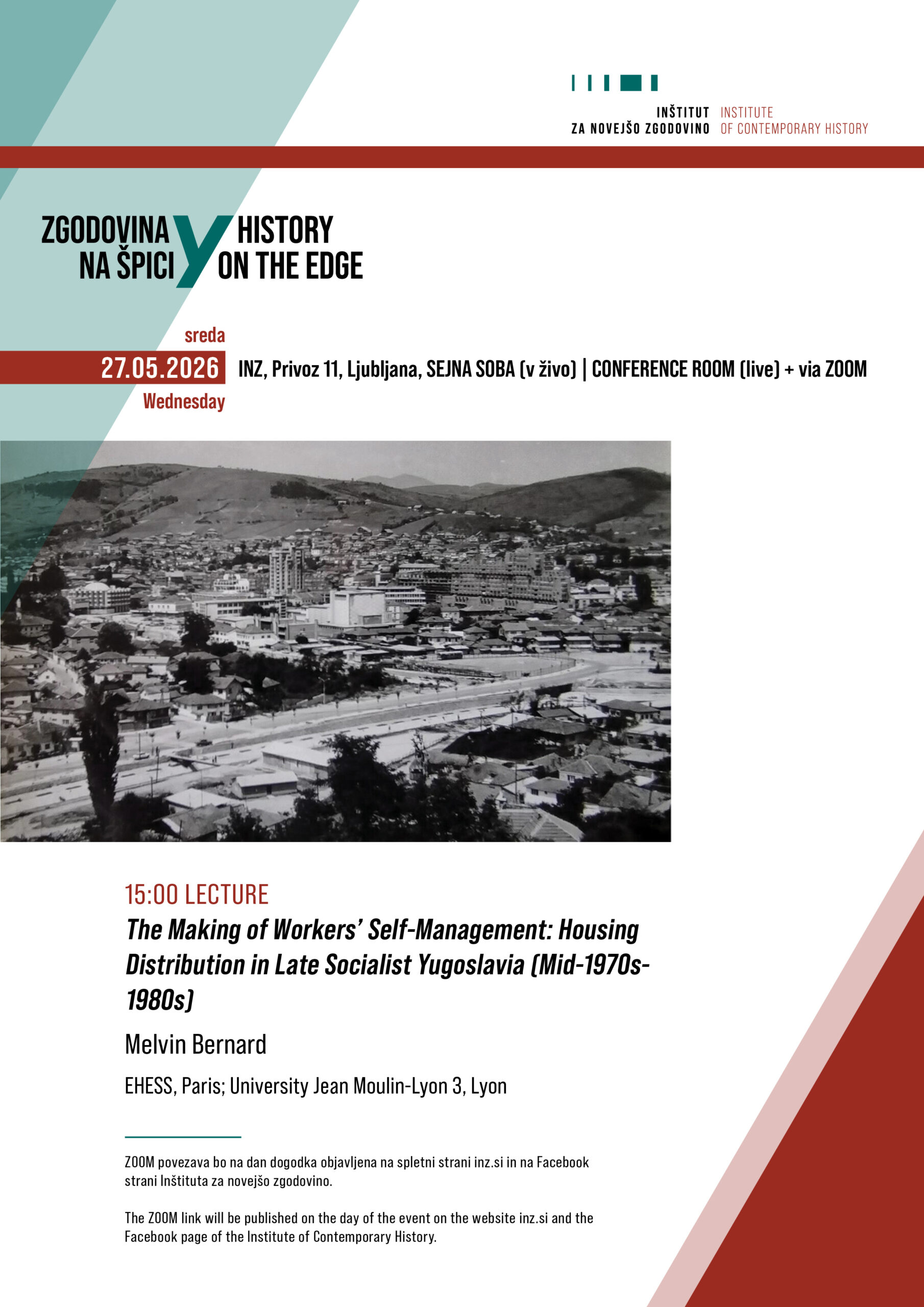
HISTORY ON THE EDGE: THE MAKING OF WORKERS’ SELF-MANAGEMENT: HOUSING DISTRIBUTION IN LATE SOCIALIST YUGOSLAVIA (MID-1970S-1980S)
You are kindly invited to a new lecture in the History on the Edge series, which will take place on Wednesday, May 27, 2026, at the INZ premises or via the ZOOM link: https://us06web.zoom.us/j/85093074535?pwd=chFdSCgScVg8fw1djh3bVz8h9gqWtm.1 . In the new season, lectures will take place at 3 p.m. and if you will be joining us in person, you are welcome to a coffee 20 minutes before the lecture begins.
The lecture will be given by Melvin Bernard, and the title of the lecture is “The Making of Workers’ Self-Management: Housing Distribution in Late Socialist Yugoslavia (Mid-1970s-1980s)”. The lecture will be held in English.
The Making of Workers’ Self-Management: Housing Distribution in Late Socialist Yugoslavia (Mid-1970s-1980s)
This presentation examines access to housing in late socialist Yugoslavia after the major mid-1970s reforms. By focusing on the evolution of social policy under self-management, it will assess the consequences of the increasing responsibilities of work organisations on citizens’ daily lives. In the last decades of socialism, municipalities withdrew from direct housing distributions, and Yugoslavs were supposed to apply through their work collective in order to obtain a subsidized socially-owned apartment or low-interest housing loan. According to the newly reformed self-managed framework, the workers’ council of each company was required to draft an allocation rulebook and submit it to approval by referendum. The implementation of new laws on housing relations led to the generalisation of such documents and point-based systems intended to ensure transparency in ranking workers. Yet the local elaboration of these rules often generated heated debates over criteria, which revealed competing conceptions of social justice, and tensions between redistributive priorities and economic considerations. Even once the document was approved, the final ranking remained delicate, and sessions of the workers’ councils were regularly dedicated to the assessment of written and oral protests from workers who opposed the evaluation of their individual situation.
Examining company-based housing policies thus provides a broader overview of workers’ self-managed organisation…thus allows for a broader overview of the workers’ self-managed organisation in late socialist Yugoslavia, by shedding new light on workers’ participation, the role of unions, the process of decision-making, and the relations of domination in self-managed companies. These company-based distributions also gradually became a field of intervention for new public actors, who reshaped the practical meaning of the “withering away of the state” in late socialist Yugoslavia.
The presentation will draw on archival research conducted in Serbia and Croatia, combining a federal perspective with two local case studies: Bjelovar and Novi Pazar. Municipal and enterprise records allow for a reconstruction of the networks and practices that shaped housing policy in late socialism.